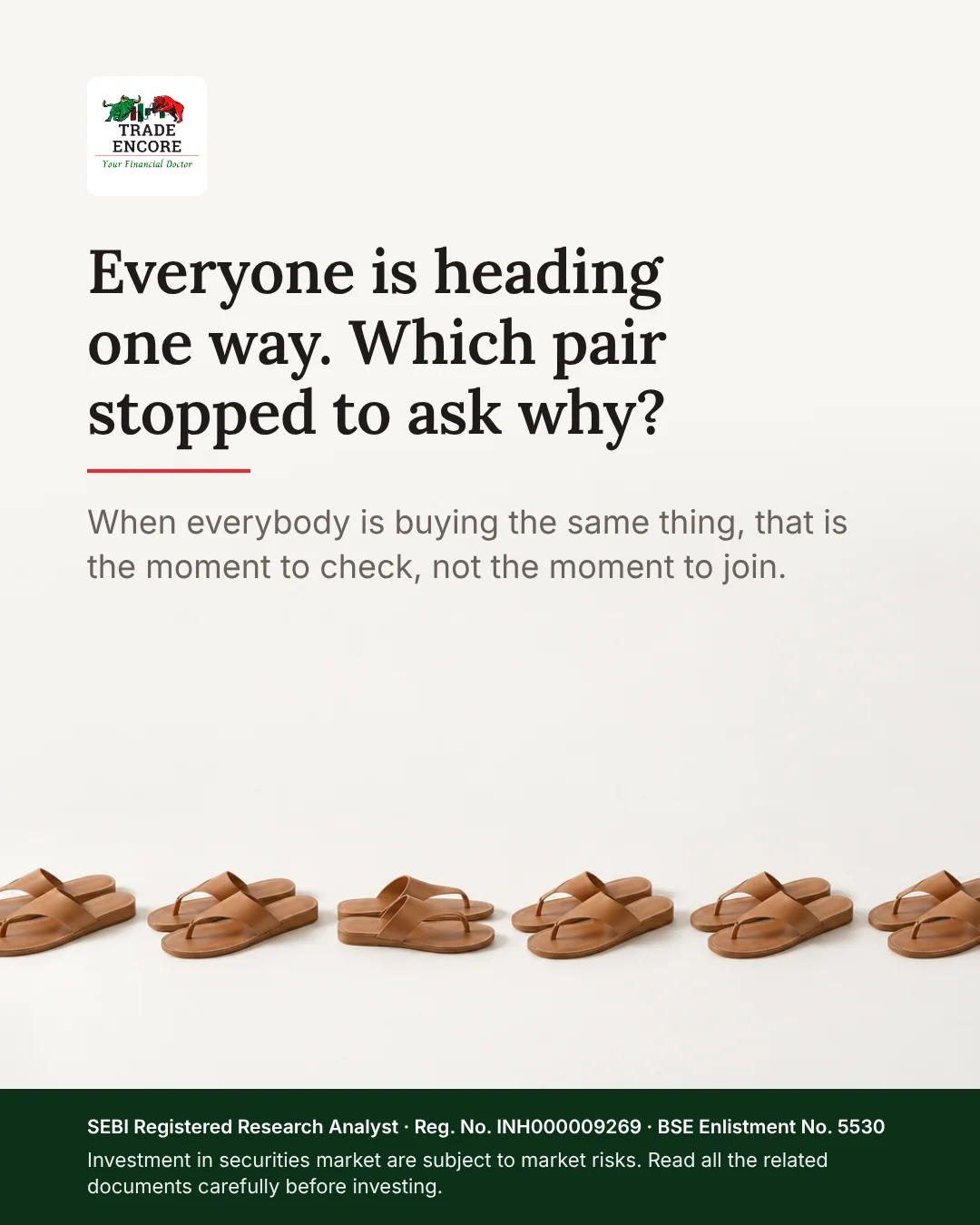
Stand outside a busy temple on a festival morning and look at the steps. Dozens of chappals, all left in a hurry, all pointing the same way: towards the door, towards wherever everybody else was going. Nobody arranged them. Each person simply followed the feet in front of theirs.
Now picture one pair turned round, pointing back towards the road. Somebody stopped, looked at the queue, and asked a question before walking in. That pair is the subject of this post.
Why crowds feel safe
Following the crowd is not foolish. For most of human history it kept people alive: if the whole village is running, you run first and ask later. On an ordinary day it still works. A busy restaurant usually has decent food, and a crowded shop is usually crowded for a reason.
Money is where the habit misleads us. When a relative, a WhatsApp group and three neighbours are all talking about the same thing to buy, it stops feeling like a decision and starts feeling like common sense. Not joining feels like the risk. That feeling has a name, the fear of missing out, and it is one of the most expensive feelings an investor can have.
What the crowd changes
When everybody wants the same thing at once, two things quietly happen.
- The price moves before you arrive. Whatever the crowd is buying has already been bought by the people who got there first. You are paying for their enthusiasm as well as for the thing itself.
- The reasons get thinner. The first people usually bought for a reason they could explain. By the time a story reaches the fifth forward, the reason is often just that everybody else is buying.
Neither of these means the crowd is wrong. It means the crowd is not a reason. A good decision and a bad one can look exactly the same from inside a queue.
Three questions before you join
The turned-round chappal does not refuse to go in. It checks first. Before you put money into anything because everyone else is, ask yourself three plain questions.
- Can I explain why, in my own words, without mentioning other people? If the only reason you can give is that others are buying, you do not have a reason yet.
- Does this fit a goal I already had? Money set aside for a child's education, a home or retirement has its own job. A crowd's excitement does not change that job.
- What happens to me if the crowd turns round? Crowds leave as fast as they arrive. If losing this money would hurt your household, the size is wrong, whatever the story.
If you can answer all three calmly, joining may be perfectly sensible. If you cannot, waiting a week costs you very little. The urgency is almost always borrowed from other people.
The quiet habit that helps
Write your reason down before you act, in one or two sentences, with the date. It feels unnecessary. It is the single most useful thing an ordinary investor can do, because later, when everyone is talking about something else, you will be able to read what you actually believed and judge it honestly, not by what the crowd felt at the time.
The lesson on the temple steps
When everybody is buying the same thing, that is the moment to check, not the moment to join. Be the pair that stopped to ask why. You may still walk in. You will just know why you did.
Words like this one come up often. Look up any term you meet in our glossary, or try the free money cases in the Case Lab, where every choice shows you what follows.
Trade Encore · SEBI Registered Research Analyst · Registration No. INH000009269 · BSE Enlistment No. 5530 · Registered office: C/O ScaleUp CoWork, Ground Floor, KBC Building, DG Dani Road, Law College Road, Deccan, Pune — 411004.
Investment in securities market are subject to market risks. Read all the related documents carefully before investing.
Registration granted by SEBI, membership of a SEBI recognized supervisory body (if any) and certification from NISM in no way guarantee performance of the intermediary or provide any assurance of returns to investors. Past performance is not indicative of future results.
Non-personalised research: This article is investor education. It is identical for every reader and is not based on your holdings, financial situation, risk profile or investment objectives. It names no security, quotes no return and is not a recommendation or investment advice. Consider your own circumstances before acting.
AI use: the wording of this article was drafted with an AI writing assistant (Claude, made by Anthropic) and read and approved by the research analyst before publication. The picture in the graphic was made with an AI image model; every word on the graphic was set by a program, not by the image model.