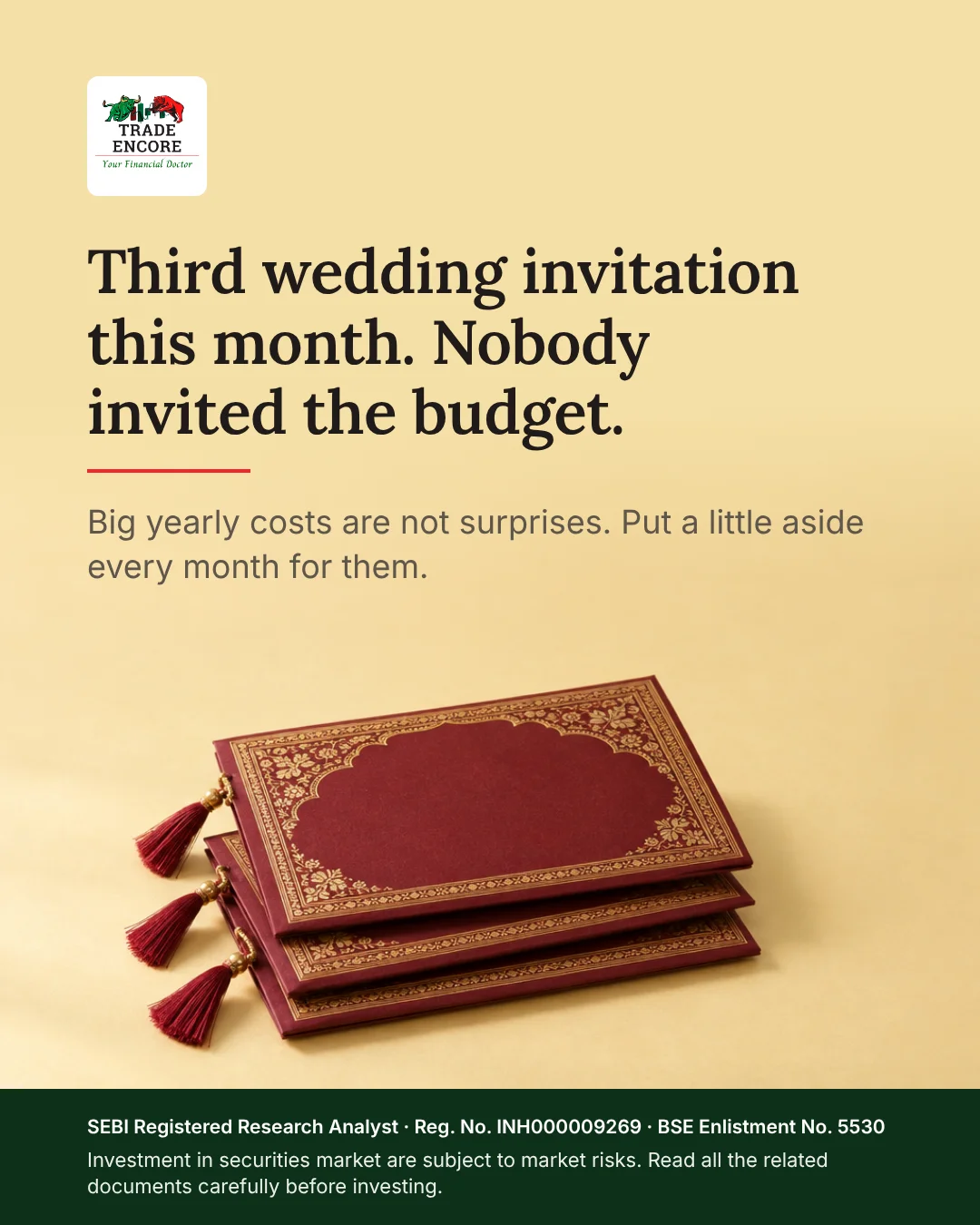
The first card arrives in early November, heavy and gold-edged, with a tassel. You are delighted. The second arrives a week later, and you start counting outfits. By the third, the cards are stacked on the shelf beside the television, and somewhere between the sangeet, the gift and the train tickets home, the month's budget has quietly left the building. Nobody sent it an invitation.
Here is the strange part. None of this was a surprise. Wedding season comes every winter. So do Diwali, the school fees in June, the car insurance renewal, the annual maintenance charge for the flat and the relative whose birthday you never forget. We know these costs are coming, often to the week, and yet they keep landing as if they fell from the sky.
Why known costs feel like shocks
Most of us budget by the month, because salary arrives by the month. A cost that turns up once a year does not fit in that box, so it is left out of the plan altogether. Then, in the month it arrives, it has to be paid from whatever is lying around: the savings meant for something else, a monthly investment that gets paused "just this once", or a credit card.
That last one is the expensive habit. A wedding put on a card and paid off slowly can cost far more than the wedding gift ever did. Our free Case Lab walks through exactly this in The minimum due, and the arithmetic is worth seeing once.
The other cost is quieter. Every time a known expense raids your long-term savings, the plan that was meant to run for years gets interrupted. A plan that stops every November is not really a plan.
How to invite the budget in advance
1. List the costs you already know
Sit down once with last year's bank statement and write down every large cost that came round once a year or once a season: festivals, weddings, school fees, insurance premiums, travel home, the annual service of the car. Most families find the list is longer than they expected, and almost nothing on it is truly unexpected.
2. Divide by twelve
Add up the year and divide it by the months left until each cost is due. That monthly figure is what those events actually cost you. It is usually small enough to carry, which is the whole point: a large bill is just a small monthly one that nobody paid in advance.
3. Give it a separate home
Move that monthly amount on salary day into an account kept only for these costs. Keep it apart from your emergency fund, which is for what you cannot predict, and apart from your long-term investments, which should never be touched for a wedding gift.
4. Spend it without guilt
When the card with the tassel arrives, the money is already waiting. You can say yes, buy the gift and book the ticket, and your long-term plan never notices.
The lesson in the stack of cards
Big yearly costs are not surprises. Put a little aside every month for them, and the season becomes something to enjoy rather than something to recover from.
Want to practise the habit on a fictional family first? Try The minimum due and The salary that didn't come in our free Case Lab, or look up any term in the glossary.
Trade Encore · SEBI Registered Research Analyst · Registration No. INH000009269 · BSE Enlistment No. 5530 · Registered office: C/O ScaleUp CoWork, Ground Floor, KBC Building, DG Dani Road, Law College Road, Deccan, Pune — 411004.
Investment in securities market are subject to market risks. Read all the related documents carefully before investing.
Registration granted by SEBI, membership of a SEBI recognized supervisory body (if any) and certification from NISM in no way guarantee performance of the intermediary or provide any assurance of returns to investors. Past performance is not indicative of future results.
Non-personalised research: This article is investor education. It is identical for every reader and is not based on your holdings, financial situation, risk profile or investment objectives. It names no security, quotes no return and is not a recommendation or investment advice. Consider your own circumstances before acting.
AI use: the wording of this article was drafted with an AI writing assistant (Claude, made by Anthropic) and read and approved by the research analyst before publication. The picture in the graphic was made with an AI image model; every word on the graphic was set by a program, not by the image model.