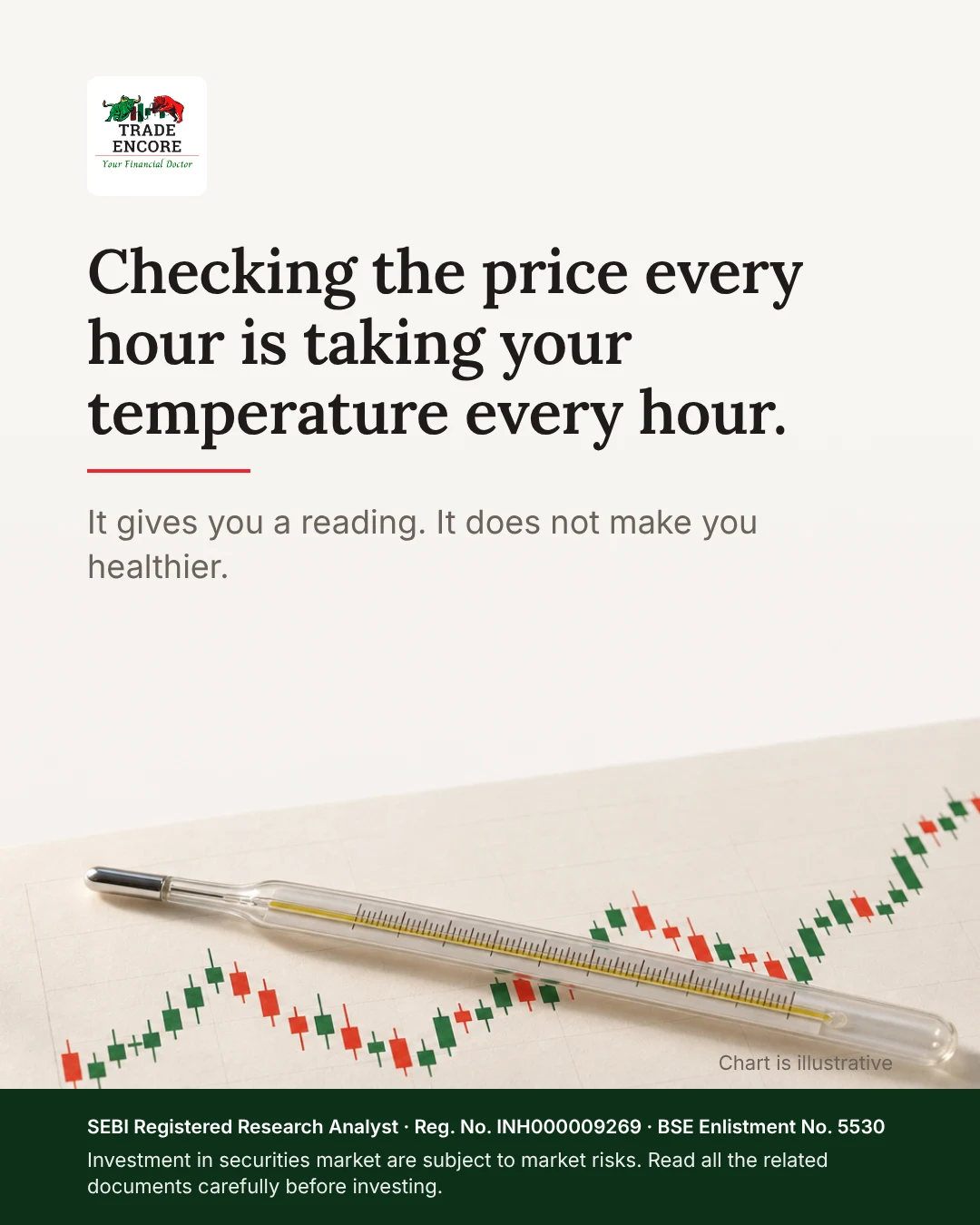
Imagine catching a mild fever and taking your temperature every hour. Nine o'clock, ten o'clock, eleven. The reading moves a little up, a little down. By evening you have a notebook full of numbers, a lot of worry, and exactly the same fever. The thermometer was never the medicine. It only told you how you were.
Checking the price of your investments all day works the same way. The app opens before breakfast, again at lunch, again in the lift, again just before sleep. Each look feels like taking care of your money. None of them changes what it is doing.
A reading is not a treatment
Prices move every minute the market is open, and most of that movement is noise. Over a single day, the direction of a move is close to a coin toss; what tends to persist is how much prices move, not which way. Our own study of the market, summarised on the Insights page, finds exactly that: busy days cluster together, calm days cluster together, and the daily direction tells you very little about the next day.
So an hourly check gives you a fresh reading of something that was always going to wobble. It does not tell you whether the business you own is better or worse than it was last month, and it does not tell you whether your plan still fits your goal. Those are the questions that matter, and they do not change by the hour.
Why we keep checking anyway
- It feels like doing something. Looking is easy, and it gives the comfort of being in control without any of the work.
- Losses shout louder than gains. A red number seen ten times hurts ten times, even when the end of the year looks nothing like the middle of a Tuesday.
- Every look invites a decision. The more often you check, the more often you are tempted to tinker, and tinkering is where most of the damage is done.
How to look less and decide better
1. Pick a review day
Choose one day a month to look properly, and one day a year to review the whole plan: your goal, your timeline, your insurance, your emergency fund. On every other day, there is nothing you need to see.
2. Ask a better question than "is it up?"
On review day, ask whether anything has changed about the reason you invested, not whether the price moved. A price moving is the market doing its job.
3. Move the app off your home screen
A small amount of friction removes most of the habit. If checking takes three taps instead of one, you will do it when you mean to, not when you are bored.
4. Write down what you will do in a fall
Decide in advance, while you are calm, what a sharp drop means for you. Usually the answer is "nothing, the plan continues". Having it written makes the bad day easier to sit through.
The doctor's note
A thermometer gives you a reading. It does not make you healthier. Look at your investments often enough to know they are on course, and rarely enough that the looking does not start making decisions for you.
Want to understand the words you see when you do look? The glossary explains them in plain English and Marathi.
Trade Encore · SEBI Registered Research Analyst · Registration No. INH000009269 · BSE Enlistment No. 5530 · Registered office: C/O ScaleUp CoWork, Ground Floor, KBC Building, DG Dani Road, Law College Road, Deccan, Pune — 411004.
Investment in securities market are subject to market risks. Read all the related documents carefully before investing.
Registration granted by SEBI, membership of a SEBI recognized supervisory body (if any) and certification from NISM in no way guarantee performance of the intermediary or provide any assurance of returns to investors. Past performance is not indicative of future results.
Non-personalised research: This article is investor education. It is identical for every reader and is not based on your holdings, financial situation, risk profile or investment objectives. It names no security, quotes no return and is not a recommendation or investment advice. Consider your own circumstances before acting.
AI use: the wording of this article was drafted with an AI writing assistant (Claude, made by Anthropic) and read and approved by the research analyst before publication. The picture in the graphic was made with an AI image model; every word on the graphic was set by a program, not by the image model.