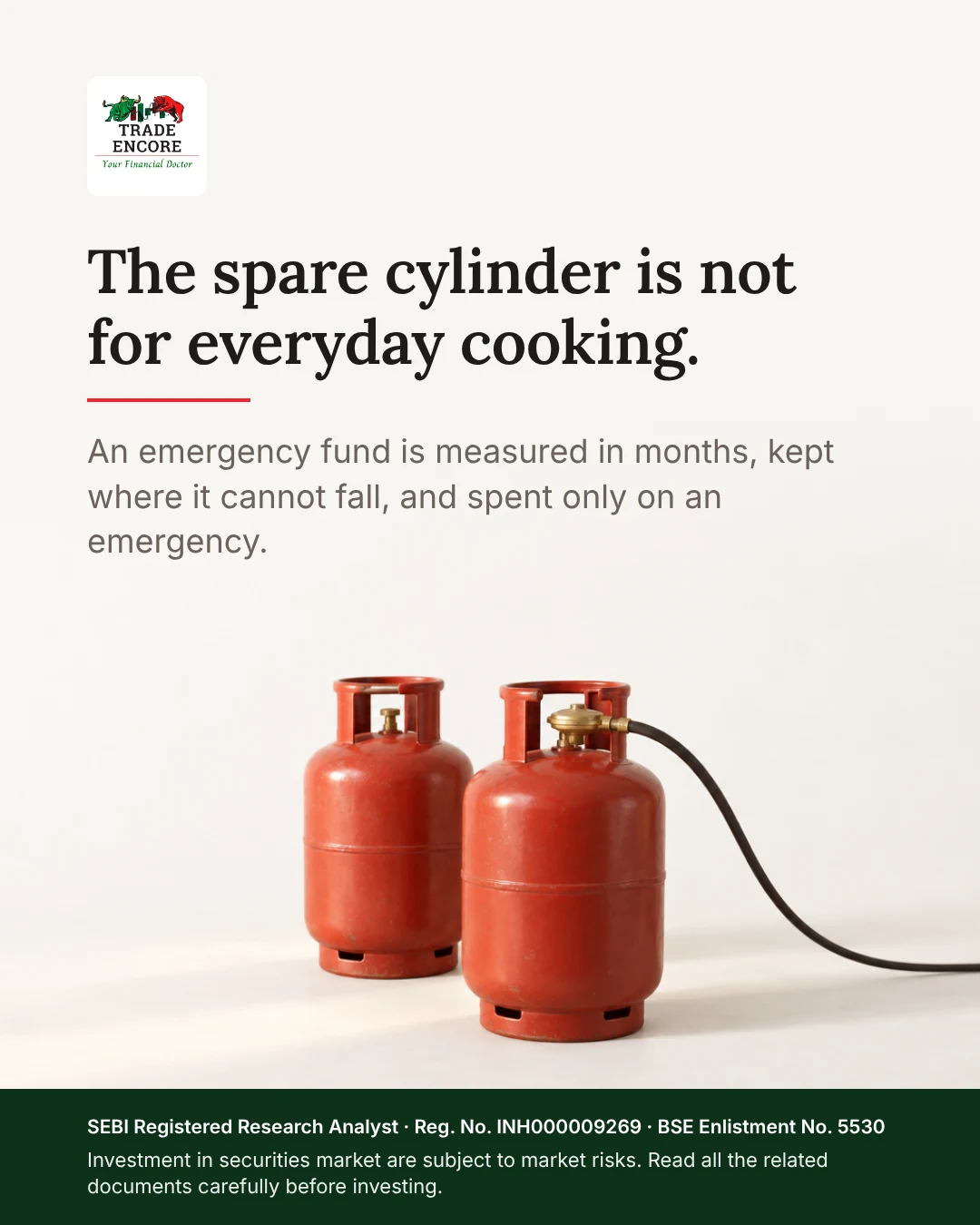
In most Indian kitchens there are two gas cylinders. One is connected to the stove and does the daily work. The other stands in the corner, sealed, with its cap still on. Nobody uses the spare to make tea faster or to cook an extra dish on a Sunday. It waits for one moment: the evening the first cylinder runs out halfway through the dal, and the next booking is days away.
Families understand this without being taught. The spare cylinder is not extra gas. It is the reason dinner still happens when something goes wrong. An emergency fund is exactly the same idea, applied to money, and it is the one most households skip.
What the spare is for
An emergency fund pays for the things you cannot schedule: a job that pauses, a salary that arrives late, a hospital bill the insurance does not fully cover, an urgent trip home. It is different from the money you set aside for known yearly costs like weddings, festivals and school fees. Those come round on a calendar. An emergency does not send a card.
Without a spare, an emergency is paid for with whatever is closest: a credit card at a high rate of interest, a loan from a relative, or the long-term savings that were meant to run quietly for years. Each of those turns one bad month into a problem that lasts much longer.
How big should it be?
Measure it in months of spending, not in a round number. Add up what your household spends in an ordinary month, including the EMI, rent, groceries and school fees, and multiply.
- Three months is a common floor. It covers a delay, a short gap or a large unplanned bill.
- Six months suits a household with one earner, an EMI that cannot pause, or children who depend on that income.
- Beyond about nine months the cushion is generous, and money parked for a crisis is money that is not working for anything else.
Our free Case Lab works through exactly this with a fictional family in Pune in The salary that didn't come. It is worth playing once just to see how quickly one month's cushion runs out.
Where to keep it
The spare cylinder stands where you can reach it in a minute, and it is sealed so it cannot leak. Your emergency fund needs the same two qualities: you should be able to reach it within a day, and it should be worth the same in a bad month as in a good one.
That is why it usually sits in a savings account, or a fixed deposit that can be broken in a day. Anything whose value swings with the market is the wrong place, because emergencies have a way of arriving in the same months as falling prices. Keep it in a separate account from your everyday spending, so it is not slowly used for ordinary cooking.
Only for an emergency
The hardest part is not building the fund. It is leaving it alone. A sale, a new phone or a holiday is not an emergency, however tempting the offer. Before you touch the money, ask one question: would this still need paying if I had no savings at all? If the honest answer is no, it can wait.
And when you do use it, refill it first, before anything else. A spare cylinder that is never replaced is not a spare.
The lesson in the corner of the kitchen
An emergency fund is measured in months, kept where it cannot fall, and spent only on an emergency. Build it before anything else, and every other plan you make gets to keep running when life interrupts.
Want to see the arithmetic on a fictional family first? Try The salary that didn't come in our free Case Lab, or look up any term in the glossary.
Trade Encore · SEBI Registered Research Analyst · Registration No. INH000009269 · BSE Enlistment No. 5530 · Registered office: C/O ScaleUp CoWork, Ground Floor, KBC Building, DG Dani Road, Law College Road, Deccan, Pune — 411004.
Investment in securities market are subject to market risks. Read all the related documents carefully before investing.
Registration granted by SEBI, membership of a SEBI recognized supervisory body (if any) and certification from NISM in no way guarantee performance of the intermediary or provide any assurance of returns to investors. Past performance is not indicative of future results.
Non-personalised research: This article is investor education. It is identical for every reader and is not based on your holdings, financial situation, risk profile or investment objectives. It names no security, quotes no return and is not a recommendation or investment advice. Consider your own circumstances before acting.
AI use: the wording of this article was drafted with an AI writing assistant (Claude, made by Anthropic) and read and approved by the research analyst before publication. The picture in the graphic was made with an AI image model; every word on the graphic was set by a program, not by the image model.